
Introduction
In the fast-paced digital world of today, a company’s website is often the first impression. For a business owner, a beautiful site needs to be complemented by speed and performance. Web optimization means improving website performance in speed, usability, SEO, and conversion rates. For business owners, these factors are the differences between a website that just exists and one that drives growth. With online competition at an all-time high, having an optimized website is no longer a choice but a necessity. A slow website or one that is poorly optimized can lead to lost profits, increased bounce rates, and lousy user experience, regardless of the industry.
The common misconception amongst business person is that website optimization is solely a developer’s task. This is however more than just a developer’s responsibility for strategic decisions by the business owner influence the overall success of the efforts. Optimization is closely linked with a plethora of things such as how well your website gets rated on Google, how fast a customer can check out, or contact you. In this article, we analyze the basics of web optimization that every business owner is supposed to follow. Speed improvements, mobile responsiveness, content strategies, and SEO best practices will all be covered in a way that is easy to grasp-no technical degree required to stand this way.
Speed Optimization: The Foundation of Performance
Why Website Speed Directly Impacts Your Bottom Line
Certainly, a slow loading website is one of the quickest ways a potential customer can disappear. Research consistently shows that users expect a website to load within three seconds. Anything over that dramatically heightens the probability of that visitor bouncing away, never to return. Now, to business owners, this is not just a technical nuisance but a direct revenue killer. Ask them to spend a fortune on marketing only to find potential leads abandoning their site due to slow performance. Web speed affects user experience, search rankings, and, ultimately, conversion rates. Even Google considers it a ranking factor; hence, a slow site won’t only frustrate users but will also rank poorer in the search.
The website speed depicts a lot of factors like the image size, server response time, third-party scripts, and unoptimized code. Tools such as Google PageSpeed Insights, GTmetrix, and Pingdom diagnose what’s holding your site back and give suggestions on resolving issues. As a business owner, you must work closely with your developer or web team so that speed audits can be embedded in your digital strategy. You should start with a reputable hosting company with great uptime and fast server response. Speed is not a single fix-it-all; it requires constant attention and adjustment as you grow and evolve in the online segment.
Best Practices to Improve Loading Time
You don’t need a whole rework if you want to speed up your website; just a few smart tweaks can effect a great change. The easiest gain comes from image optimization. Large images tend to slow down your website pretty much, especially on mobile. TinyPNG or ImageOptim can help compress images without compromising quality. To cut down even more on file size and keep images looking good, use next-gen formats like WebP. Browser caching is another area to look into; this temporarily retains some website features on users’ systems so they won’t have to download them again and again on every visit. This goes a long way towards improving load times for users who return.
Afterwards, it is recommended that you take a minification approach for your code, which refers to the act of having unnecessary characters such as white spaces, comments, and line breaks stripped from files like HTML, CSS, and JavaScript. Therefore, this reduces the code that must be processed by the browser, thus enabling fast rendering. CDNs like Cloudflare or AWS CloudFront serve your content from multiple servers spread all over the globe so the content can reach the visitors faster regardless of their location. And finally, avoid third-party scripts as much as possible. Plugins, widgets, and ads can pile up extra requests and cause slow down. While such functionalities can be helpful, a fine balancing act must always be maintained-compromising performance for added functionality.
Mobile Optimization: Capturing the Mobile Audience

The Rise of Mobile Traffic and Its Importance
More than half of all web traffic across the world is now from mobile devices. If your site is not mobile-friendly, you’re putting off a large percentage of your prospective clientele. Mobile optimization is something every business owner must understand is essential, not optional. A mobile-optimized site means readable content, ease of navigation, and flawless functioning of all features at different screen sizes. Bad mobile experience can very well frustrate the users, and they will abandon it and possibly look for alternatives, mainly your competitors. Such behavior will severely damage your bounce rate, conversion rate, and brand perception.
Google further operates under the premise of mobile-first indexing, wherein it uses the mobile version of one’s website for ranking and indexing. This makes mobile optimization a must, not only for use but also for SEO performance purposes. Responsive designs, lightning speeds in mobile loading, and easy navigation even for the thumbs have become the very basic necessities of now. The end result fails; that is the likelihood a user not using the site or buying from it. Such an enterprise is that which gives services on localities and hence should take much greater cognizance on mobile queries; many customers would find you on the maps or from mobile searches outside. The entire satisfaction of users and chances of conversion primarily rely on how well optimized that very mobile interface is.
Practical Steps to Make Your Site Mobile-Friendly
Responsive design is the first step on the road to mobile optimization. Responsive design ensures that a website’s layout is automatically adapted depending on the user’s screen size. Therefore, content is designed to look great and perform effectively on any device, be it a smartphone, tablet, or desktop. Test your site’s mobile responsiveness by either using Google’s Mobile-Friendly Test tool or simply by resizing your browser window. Another issue to consider is font size and spacing. Text should be large enough for the user to read without zooming. Button taps should be discreet enough to avoid other accidentally clicked elements. Dreadful spacing leads to severe usability problems on touchscreens.
Next, consider the speed of mobile loading. Since mobile devices usually work using a slow network, it is advisable to reduce file sizes and limit large complex animations or high-resolution media. Use Accelerated Mobile Pages (AMP) to power lightning-fast stripped-down versions of your web pages. These include pop-ups or interstitials that will block access to content or aren’t easy to close on mobile devices—they tend to frustrate users and get penalized by Google. Simplify your menu and navigation with menu items using mobile-friendly formats, such as hamburger menus, or collapsible sections for things. The aim is to adjust friction down and facilitate things as much as possible for users to take action-either to browse, contact, or purchase.
SEO Optimization: Boosting Visibility and Organic Traffic
Understanding SEO’s Role in Online Success
Search Engine Optimization, or SEO, refers to the strategic techniques that webmasters use to optimize their websites to appear on the first pages of popular search engines such as Google, Yahoo, and Bing. It’s the magic wand for business owners to drive traffic organically to their websites and bridle them from dependence on paid ads. A well-optimized site comes high in search results when potential customers are looking for products or services that you offer. Google rankings lend respectability to the business and increase click-through rates. The best part? Unlike PPC, organic traffic does not incur a cost-per-click, making it a sustainable and cost-effective investment in the long term.
SEO, an abbreviation for Search Engine Optimization, delineates both on-page strategies and off-page strategies. On-page SEO centers on the optimization of the content of a website in terms of its keywords and phrase density, title, meta description, headings, images, and internal linking. Off-page SEO actually refers to the external search ranking factors such as valid backlinks from credible sources, reviews on online platforms, and citations of local businesses. The performance of a website, including its mobile-friendliness and user-engagement metrics like bounce rate and time on page, will also rank. One major principal should be kept in mind by business owners while working on their web presence: the content should be truly helpful to solve their audience’s problems but must also stay SEO-friendly. SEO does not give results overnight, but the long-lasting benefits of it will accrue over time.
On-Page SEO Techniques Every Business Owner Should Know
On-page SEO encapsulates everything you do on your website to improve ranking. At first, it is necessary to perform keyword research. Using tools like Google Keyword Planner, SEMrush, or Ahrefs, find out what your target audience has been searching on. Focus on the long tail keywords closely related to your offerings but still manageable in competition. Incorporate these keywords in as natural way possible within the content, headings, and meta tags. Never overstuff the keywords in your pages; you will only get yourself penalized. It should be within smoothness with user-first experience but satisfy search engine algorithms as well.
Next, as appropriate description should be given in the URLs of the website, the URLs should be small and understandable and include target keywords when necessary. Each and every page would have a unique meta title and meta description for the purpose of informing search engines about the page’s purpose. Apply header tags (H1, H2, H3) for content organization through hierarchical means and ease user and crawler navigation. Internal links should be incorporated referencing other relevant pages within the site to heighten the time spent under session and to share authority as well. Last but not least, image/file optimization – use descriptive filenames and alt text to improve access and image search visibility. These small strategic changes improve collectively your SEO performance and improvement in user engagement.
Conversion Optimization: Turning Visitors into Customers
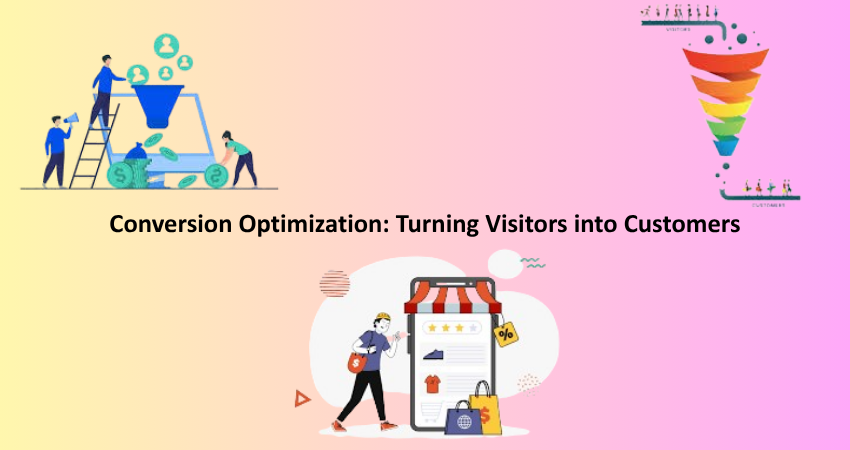
The Importance of Optimizing for User Actions
The other half is bringing visitors to the website. Then your next goal would be to convert them into paying customers, newsletter subscribers, or leads. And that is where conversion rate optimization (CRO) comes in. CRO is all about optimizing aspects of your website so that users are persuaded to carry out certain actions. Whether that action is filling out a contact form, purchasing a product, or signing up for a free trial, every user journey should be intentional and frictionless. Business owners who understand CRO will always be better poised to increase their ROI on existing traffic without having to spend extra money in advertising.
Try to evaluate click-through, form completion, and bounce rates and the time spent on a site, as these are key performance indicators for the conversion rate optimization (CRO). Observing the data could show drop-off points where users lose interest or fail to understand. Impediments to conversion–like a messy homepage, unclear CTA, or protracted checkout–may be worked on by doing incremental changes A/B testing on layouts, headlines, or button placements to see what really works for you. By optimizing for conversions, one maximizes value per visitor and builds a website that assists in fulfilling business objectives.
Elements That Influence User Behavior and Conversions
Several factors influence user interaction and conversion. The first among these is the call to action. Whether it reads ‘Buy Now,’ ‘Schedule a Demo,’ or ‘Get a Free Quote,’ a strong, active and immediately relevant benefit should underpin CTAs. It must also be cased; your CTAs should show up above the fold and again at points in your content where it logically follows. Use the most contrasting colors and the clearest language possible to attract the attention of a user and lead him or her to take action. Testing multiple variations of each one through A/B testing is critical for finding the most successful version.
Such other importance is attaching to trust signals which include customer reviews, testimonials, case studies, security badges and return policies. It is a must that one must feel competent before giving away personal data or making a purchase. A professional-looking design, fast performance, and clear navigation also impressively affect perception and trust. Minimize user hesitation by providing clear next steps and taking away distractions. Forms should be kept short with only the basic information required. Guarantees, free trials, or risk-free demos also reduce the psychological barrier of conversion. Every tweak should be moving toward minimizing any friction and establishing confidence in your brand and offerings.
Conclusion
Web optimization is a topic that is no longer on the periphery of the high-tech and advanced domain; it is becoming a paramount business concern now. Everything-digital speed, mobile responsiveness, SEO, and conversion strategy-can have a bearing on how customers find you, schmooze around, and make a sale with you. Early in this process, web optimization will have served the business owner well in creating competition, generating leads, and increasing customer satisfaction in the online world. Basic principle knowledge about web optimization goes a long way toward forming effective collaborations with developers, designers, and marketers to present a high-performing web presence.
As dazzling as it might seem, web optimization is much easier to accomplish if one compartmentalizes it into a few strategic and manageable components. Start from the beginning: speed, mobile-friendly, SEO, conversion. Slowly, but surely, the website will become a marketing stronghold and buttress brand authority in the digital marketplace.